If you’ve ever tried to make a left turn out of the Teton Science Schools (TSS) Jackson Campus, or out of Indian Springs Ranch, you know the feeling…edge forward, scan for a gap, and hope the steady flow of Highway 22 traffic blinks first.
Now, TSS and the Indian Springs Ranch HOA are proposing a fix designed to take left turns off the menu entirely.
A single-lane, box-culvert vehicle underpass beneath WY-22, with the potential for a separate pedestrian/bike underpass alongside it.
And this isn’t just talk. The concept was formally presented as a workshop item to the Teton County Board of County Commissioners on Feb. 17, 2026, complete with a project overview, decision options for county participation, and a target construction start date.
What’s Being Proposed
According to the project presentation delivered to commissioners, the concept includes:
- A 16-foot-high by 16-foot-wide vehicle underpass beneath Highway 22 (a box culvert design).
- A single-lane configuration, with traffic control elements to prevent opposing vehicles from entering at the same time.
- Short connector segments that would allow vehicles to avoid left turns onto or across WY-22, instead routing through the underpass and making safer right-turn movements.
- A roundabout on Coyote Canyon Road, shown as part of the concept.
- A multimodal component. Either a separate pathway tunnel or a bike lane within the road tunnel (still to be finalized).
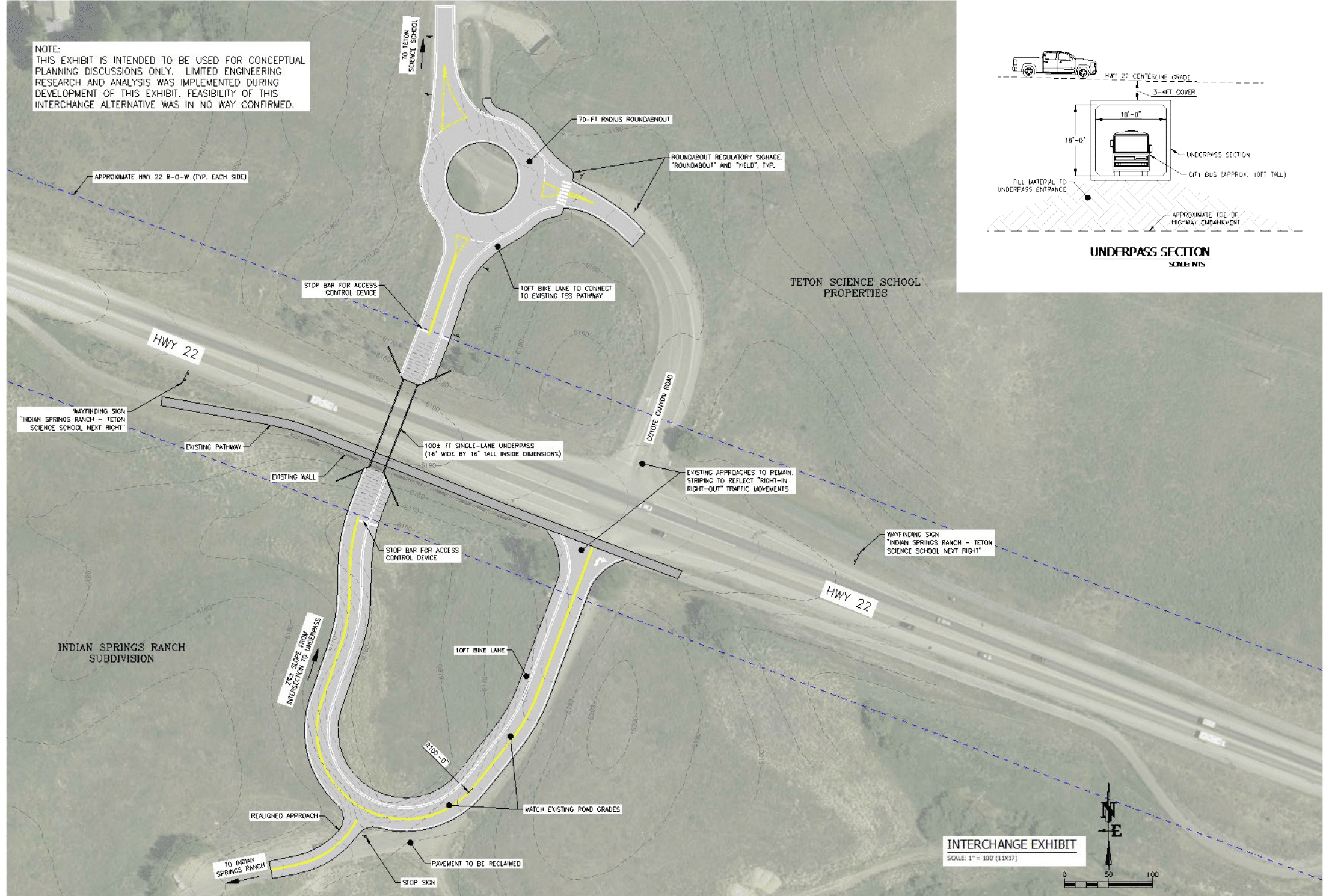
In plain terms, rather than drivers sitting at a stop sign trying to thread a left through commuter traffic, the proposal aims to re-route those movements under the highway, reducing conflict points and improving predictability at a notoriously stressful access area.
Who Pays for What
The financing structure is part of why the proposal is getting attention.
The workshop materials state that TSS and Indian Springs Ranch would fully fund the vehicle tunnel and short connectors.
The open question is the pathway / multimodal portion. The presentation outlines two paths for the county:
- Option A: Do not partner.
- Option B: Partner on design work to obtain a real engineer’s estimate, then decide later whether to participate in construction (especially for the multimodal elements).
July 2027 Timeline
The concept deck includes a stated goal of beginning construction in July 2027, dependent on funding and final design. It also notes that WYDOT has “assured” the project team they can design and build outside of the broader WY-22 corridor project framework.
That matters because WYDOT’s own WY-22 corridor project materials describe a larger NEPA process and longer-term funding uncertainty.
The Wetlands Factor: Why a Tunnel is Back on the Table
This is not only about traffic and safety. It’s also about location and impacts.
The county workshop materials highlight concerns about a nearby fen (a rare wetland) and describe the tunnel approach as a way to avoid certain roadway options that could increase wetland impacts.
In recent years, access planning in this stretch has been tied up with bigger WY-22 corridor discussions, including how Indian Springs connects to future roadway improvements (such as the Tribal Trail concept). WYDOT’s project FAQ explains why that broader corridor conversation exists and how it has been shaped by local requests and constraints.
The Pathway Issue: “Cattle Tunnel” Doesn’t Meet Spec
There’s also a non-motorized angle here that affects a lot of locals.
The presentation identifies the existing pedestrian/bike underpass east of the science school, often described locally as a repurposed cattle tunnel, as undersized and in poor condition, and indicates it would be addressed as part of the larger solution.
This aligns with the Jackson/Teton County Pathways planning framework, which has previously referenced the science school connector and the role of an underpass at WY-22.
Why This Proposal is Getting Traction
WYDOT’s corridor materials describe WY-22 as one of the most congested two-lane segments in Wyoming, with increasing traffic volumes and ongoing concerns about access, safety, and mobility.
Against that backdrop, county commissioners have repeatedly pushed for incremental, intersection-by-intersection improvements rather than relying solely on widening or major corridor reconstruction. This tunnel concept fits that theme: Focus on a specific conflict point, reduce turning conflicts, and do it in a way that avoids environmentally sensitive areas.
What Happens Next
Based on the Teton County workshop materials, the next steps are straightforward:

1. Refine engineering drawings and obtain a credible cost estimate (vehicle elements funded by TSS/ISR; multimodal funding to be determined).

2. If the county chooses to partner, develop the needed agreements (including coordination with WYDOT) and decide what portion, if any, the county funds.

3. If funding and approvals align, target July 2027 for construction to begin.

AntlersArch founder and the voice behind Teton Tattle.