Newsletter Subscribe
Enter your email address below and subscribe to our newsletter


A bipartisan bill led by Wyoming Senator John Barrasso to modernize emergency response systems in U.S. national parks cleared a key hurdle this week, advancing unanimously out of the Senate Energy and Natural Resources Committee.
The legislation, known as the Making National Parks Safer Act (S. 290), would upgrade outdated 911 infrastructure across the National Park Service, improving response times in some of the country’s most remote and heavily visited landscapes.
🔗 Full bill text: https://www.congress.gov/bill/118th-congress/senate-bill/290
The bill requires all 41 National Park Service 911 call centers to transition to Next Generation 911 (NG911) technology.
That upgrade would allow emergency dispatchers and first responders to receive:
In short: modern emergency tools for modern emergencies.
For high-traffic parks like Yellowstone National Park and Grand Teton National Park, emergency response can be complicated by rugged terrain, limited cell coverage, and sheer scale.
Millions of visitors pass through Wyoming’s national parks each year. When emergencies happen, such as lost hikers, injured climbers, and wildlife encounters, minutes matter. Supporters say NG911 technology could significantly improve rescue outcomes in those situations.
Barrasso introduced the bill alongside Maine Senator Angus King, with bipartisan co-sponsors from states with major public lands and park visitation.
The committee approved the bill unanimously, an increasingly rare outcome in Congress and a strong signal of cross-party support.
With committee approval secured, the bill now heads to the full U.S. Senate. If passed and signed into law, it would mark a nationwide upgrade to emergency communications across the National Park Service.
For Wyoming, where national parks are both an economic engine and a backyard reality, the legislation represents a practical step toward safer access to some of the state’s most iconic places.
We’ll continue tracking the bill as it moves forward.
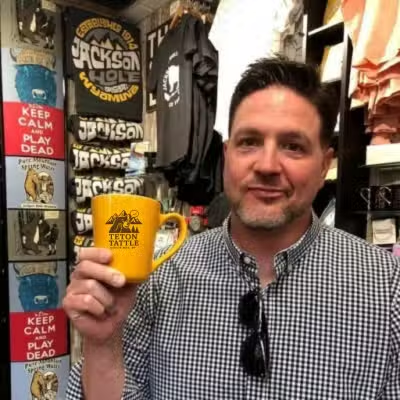
AntlersArch founder and the voice behind Teton Tattle.